Running a Marathon in Japan: Tokyo, Kyoto & Mount Fuji (from someone who’s run all three)
A runner’s guide to Japan’s marathons — Tokyo, Kyoto and the Mt. Fuji International Marathon — from someone who has run all three. Honest race comparisons, entry ballots and charity spots, travel, race-week, Pocari Sweat, costs and rankings.
I’ve now run three marathons in Japan — Tokyo in 2023, Kyoto in early 2025, and the Mt. Fuji International Marathon in December 2025 — and I’ve come away convinced that Japan is one of the great marathon destinations on earth, for reasons that have almost nothing to do with finish times. The organisation is flawless, the volunteers make you feel like an Olympian, and the trains mean the logistics that wreck a race trip elsewhere simply melt away. This is the guide I wish I’d had before the first one.
A note on how to read it: where I say "I", that’s lived experience — what the start pen actually felt like, where I struggled, what I’d do differently. Where I’m giving you dates, fees and entry windows, that’s researched and, importantly, it changes every single year. I’ve flagged the changeable facts clearly and linked the official pages, because the fastest way to ruin a Japan marathon trip is to trust a fee or a ballot date that quietly moved. Treat the numbers here as a starting point and confirm the current cycle before you commit money.
This is a running guide, but Small Steps Japan is a family site, and the two overlap more than you’d think: Japanese marathons are wonderful for the family who comes along to support. If your people are coming to watch rather than run, we have a separate, detailed Tokyo Marathon spectator guide that plans their day around the metro. This piece is for the person pinning on the bib.
Why Japan is a special place to run 42.195 km
Every marathon country has its thing. Japan’s thing is care. From the moment you collect your bib at a slick, courteous expo to the moment a volunteer bows as they hand you your finisher’s towel, you are looked after with a seriousness that borders on moving. Aid stations are immaculate and frequent. Course marshalling is precise. Nothing is chaotic. After you’ve run a few big-city marathons elsewhere, the sheer competence of a Japanese race organisation is a genuine luxury.
Then there are the crowds and the volunteers. Japanese spectators are often described as "polite" — they clap rather than roar — but don’t mistake restraint for indifference. The support is deep, constant and completely sincere, and the volunteers (there can be many thousands of them) treat runners with a respect that lifts you when the wheels are coming off at 35 km. As an international runner you should feel entirely free to cheer loudly and thank them; it’s received warmly.
And underpinning all of it is the transport. In most marathon cities, getting you, your supporters and your aching legs around race weekend is a logistical headache. In Japan the train network does the heavy lifting, which — as I’ll keep coming back to — quietly removes the single biggest source of race-trip stress.
Tokyo Marathon — the World Major, and a genuine PB course
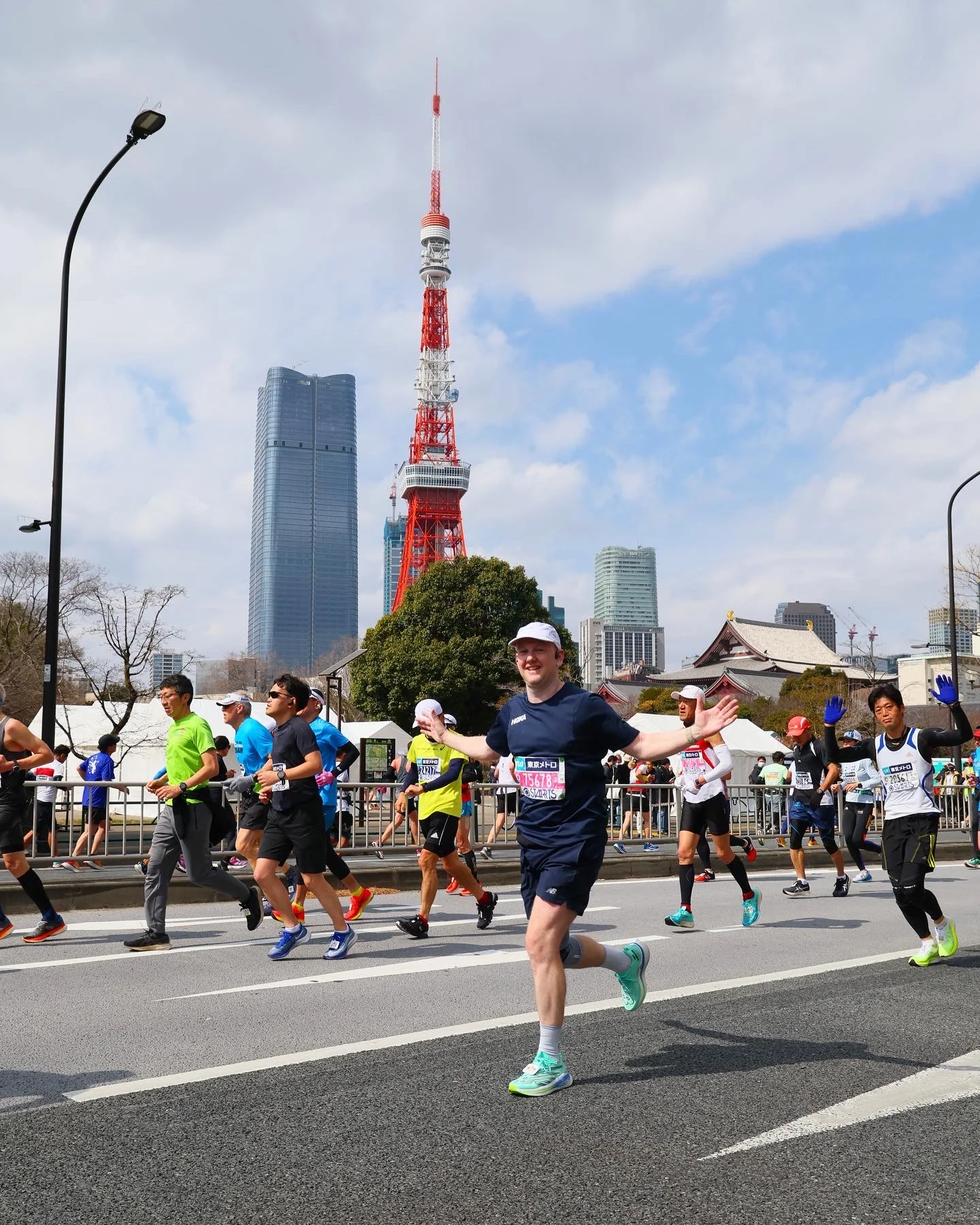
Tokyo is the one everyone wants, and deservedly so: it’s Japan’s only Abbott World Marathon Major, the organisation is world-class, and the course is flat and fast — a legitimate personal-best hunt. I ran it in 2023 and it remains the most polished mass-participation event I’ve ever been part of.
The lived reality: it is cold at the 9:10 a.m. start in early March, and you’ll stand around in your corral losing heat, so throw-away layers are essential. The first 5–10 km are genuinely crowded — the field is enormous and it takes a while to find clean air, so don’t panic about pace early or waste energy weaving. After that it opens up into a fast, supported, gloriously flat tour of the city, with an out-and-back shape that means the crowds feel constant. If you want a fast time in Japan, this is the course.
The catch is getting in. The general ballot is brutal — hundreds of thousands apply for a field of around 38,000, and widely-cited estimates put acceptance in the region of one in ten (treat that as a well-repeated ballpark, not an official figure). Most international runners who are determined to run Tokyo get there another way, which I cover in the registration section below. Be honest with yourself early about which route you’re taking, because the deadlines don’t wait.
Kyoto Marathon — the perfect first Japanese marathon
If Tokyo is the trophy, Kyoto is the one I’d send a friend to first. I ran it in February 2025 and it’s the race that made me fall for Japanese marathons as cultural events rather than just races. The course threads the old capital — past temples and along the Kamo River — and, memorably, runs right through the Kyoto Botanical Gardens. The cultural cheer is the thing you remember: geiko and maiko in full dress clapping you along, and, at Ninna-ji, monks out to encourage runners. It is unlike any road race I’ve done.
It is also, importantly, not a PB course — and nobody should come expecting one. It rolls, and there’s a genuinely cruel little climb late on, around 38–40 km on Imadegawa-dōri, exactly where you have nothing left. But that’s not why you enter Kyoto. You enter for the atmosphere, the ~7,000 volunteers, the sense of a whole city turning out, and one of the warmest, best-organised introductions to Japanese racing you can get. As a first Japanese marathon it’s hard to beat.
Mt. Fuji International Marathon — Japan’s most underrated race
This is the one almost nobody outside Japan talks about, and it might be my favourite. I ran the Mt. Fuji International Marathon in December 2025, around Lake Kawaguchi, and the scenery is simply staggering: the course runs beside the lakes with Mt. Fuji filling the sky, through traditional lakeside towns and a slice of genuinely rural Japan you don’t see on a city-marathon weekend. On a clear day you get the postcard — Fuji mirrored in the water — for kilometre after kilometre.
Set your expectations correctly and you’ll love it. It is not flat and not a PB course: it rolls, it has a well-known "heartbreak" pinch, and the whole thing sits at around 830 m of altitude beside a cold, sometimes windy lake in early winter, so it feels harder than the modest elevation numbers suggest. But as a bucket-list experience — scenery, calm, a smaller and far more enterable field than the big-city ballots — it’s outstanding. If you’ve done a flat city major and want something with soul, this is it.
How the three compare
People always ask me to rank them, and it’s the wrong question — they’re different tools for different jobs. This is how I’d actually compare them across the things that decide which one is right for you. Difficulty and scenery are my subjective read from running all three; the factual columns (weather, entry) come from the research and shift each year.
| Tokyo | Kyoto | Mt. Fuji | |
|---|---|---|---|
| Difficulty | Easy underfoot (flat), crowded early | Moderate — rolling, late hill | Hard-ish — hills, altitude, wind |
| PB potential | Excellent — flat and fast | Low — not a time course | Low — scenic, not fast |
| Scenery | Big-city landmarks | Temples, river, gardens | World-class — Fuji and lakes |
| Crowds & support | Huge, constant | Deep, cultural cheer | Smaller, friendly, rural |
| Culture | Global-major spectacle | The richest — maiko, monks | Rural, authentic, quiet |
| Organisation | World-class | Excellent | Very good |
| Getting in | Very hard (ballot) | First-come — be quick | First-come — easiest |
| Weather (race day) | Cold, ~3–13°C, early March | Cold, ~2–10°C, mid-Feb | Cold + windy, altitude, mid-Dec |
| Elevation | Flat (net downhill) | Rolling, late climb | Rolling, ~830 m base |
| International appeal | World Marathon Major | High — cultural bucket list | Underrated gem |
Registration: ballots, charity spots and being quick
Getting a bib is the part that trips people up, because Japan runs two completely different systems and the big prize uses the harder one. Broadly: the flagship city majors (Tokyo, Osaka, Kobe, Nagoya) use lotteries, while many other races — including Kyoto’s overseas entry and Mt. Fuji — are first-come, first-served and simply sell out. Your strategy differs entirely depending on which you’re chasing.
For a lottery race like Tokyo, apply in the short window (Tokyo’s general ballot is roughly two weeks in mid-to-late August for the following March) and expect to lose — the odds are long. If you’re determined to run Tokyo regardless, plan a guaranteed route from the start. The main ones are the official charity ("donation") entries and official tour-operator packages that bundle a guaranteed bib with a hotel. One thing worth correcting, because it’s widely muddled: "RUN as ONE" is Tokyo’s semi-elite, time-qualified category — it is not the charity programme. The charity route is a separate donation-for-a-bib scheme.
On charity cost specifically: the official minimum donation has typically started around ¥100,000–120,000 (roughly US$670–800 at recent rates), not the higher figures you sometimes hear. If you budget closer to US$2,000 you’re really paying for the certainty of a tour package or a competitive charity place — a reasonable "I am definitely running this" number, but be clear you’re buying insurance, not paying an official fee. For first-come races, the game is different: there’s no luck involved, just readiness. Have an account set up in advance (overseas runners often enter via portals like Run Japan or a race’s dedicated English entry page rather than the Japanese-only RUNNET), know the exact minute entries open, and be at your laptop.
A realistic registration timeline
- ~7–8 months out: pick your race and, if it’s a lottery (Tokyo), note the ballot window; if it’s first-come (Kyoto overseas, Mt. Fuji), note the exact entry-open date and time.
- ~6–7 months out: lottery applications typically open (Tokyo ~mid-August for the following March). Apply the day it opens.
- Immediately after a lost ballot: pivot to your backup — official charity entry or a guaranteed-entry tour package. Don’t wait; charity places and packages also close.
- First-come races: be logged in and ready at the open time. Kyoto’s overseas window has opened around mid-July; Mt. Fuji’s registration has opened around late April.
- 4–6 months out: once your bib is secured, book flights and the race-weekend hotel (rooms near big-city starts and finishes go early).
- 2–3 months out: book Shinkansen/side-trips, arrange travel insurance, and start trialling your race-day nutrition and hydration at home (including Pocari — more on that below).
Getting there and around: why hotel location barely matters
Here’s the single most freeing thing about racing in Japan, and it runs against every instinct you’ve built up at other marathons: you do not need to pay a premium to stay next to the start. Japan’s trains are so punctual, frequent and comprehensive that a hotel two or three well-connected stops away is completely fine — you’ll be at the start pen relaxed and on time. I’d rather have a better, cheaper room near a good station than an overpriced one by the finish. Just check your chosen hotel is a short walk from a station on a line that reaches the start, and confirm the first trains run early enough on race morning.
For getting between cities, the Shinkansen is the obvious hero — Tokyo to Kyoto is about 2 hours 15 on a Nozomi, and I’d always reserve a seat around a race weekend when trains are busy. One myth to bust for marathon travellers: the nationwide JR Pass is often not worth it any more. After the 2023 price rise, a 7-day pass costs about ¥50,000, and a single Tokyo–Kyoto round trip (roughly ¥28,000 in point-to-point tickets) doesn’t come close to justifying it. The pass only wins if you’re doing serious multi-city mileage. For a race plus one side-trip, buy individual tickets.
Rental cars have their place — but mostly for the rural races. For Tokyo and Kyoto, a car is a liability: parking is dear, city driving is stressful, and the trains are faster. For Mt. Fuji and the Fuji Five Lakes, a car genuinely opens things up if you want to explore the region around the race, though you can reach Kawaguchiko easily and cheaply by direct bus from Shinjuku (around ¥2,000, under two hours). Match the transport to the race: trains for the cities, consider a car only for the countryside.
Race week: carb-loading the Japanese way
Fuelling in the days before a Japanese marathon is genuinely easy, and honestly a bit of a joy. The classic runner’s move — a big Italian pasta dinner the night before — is very doable; every city has good Italian restaurants, and booking one for two nights out (not just the night before) is smart so you’re not carb-loading on a nervous stomach. But you don’t need to import your race-week diet at all. Japanese food is a carb-loader’s dream: rice with every meal, udon and soba, onigiri by the handful, and the humble convenience store as your best friend.
The konbini (7-Eleven, FamilyMart, Lawson) is the unsung hero of race week. Onigiri (rice balls) are cheap, portable, easy on the stomach and perfect pre-race fuel; plain white-rice options are ideal if you’re keeping it bland. You can assemble a reliable, gentle breakfast and a pocket of race-morning snacks from any konbini at any hour, which takes a lot of the "what do I eat?" anxiety out of an unfamiliar city. Keep it boring and familiar — race week is not the time for adventurous eating.
On hydration, drink to thirst in the days before and don’t overthink it, but do get your electrolytes sorted in training rather than improvising on race day — which brings me to the one drink every runner heading to Japan should know about.
Why every runner should try Pocari Sweat before race day
Pocari Sweat is Japan’s ubiquitous "ion supply" drink — an electrolyte/hydration drink made by Otsuka Pharmaceutical, and it is genuinely everywhere: vending machines on every corner, every convenience store, and, tellingly, it’s the official hydration partner of the Tokyo Marathon, so you’ll meet it on the course whether you planned to or not. It’s milder and less sweet than most Western sports drinks, which many runners (me included) find easier on the stomach over a long effort.
And that "on the course" point is exactly why this matters. The oldest rule in marathoning is: nothing new on race day. If Pocari is going to be handed to you at aid stations, the time to find out whether your gut likes it is in training at home — not at 30 km with 12 km to go. The good news is you don’t have to wait until you land: overseas runners can buy Pocari Sweat online before travelling, and the powder form (you just mix it with water) is the practical way to trial it during your long runs in the weeks beforehand. Order a bag, drink it on a couple of big training days, and you’ll know exactly where you stand.
If it doesn’t agree with you, no drama — Aquarius (Coca-Cola’s Japanese sports drink) is the other one you’ll see everywhere, and carrying your own preferred gels/electrolytes is always fine. But test the on-course drink in advance. It’s the cheapest, easiest race-day insurance there is.
The culture of a Japanese race
A Japanese marathon has a texture that’s worth understanding before you arrive, because it shapes how you behave and how much you enjoy it. The organisation is meticulous and rule-bound: follow the instructions, respect the corral system and the cut-offs, don’t litter outside the aid-station zones, and you’ll glide through. The flip side of all that structure is that everything works — bag drop, toilets, start waves, the finish flow — with a smoothness that’s a pleasure after the chaos of some other big races.
The volunteers and crowds deserve special mention. Volunteers are extraordinarily attentive and treat runners with real respect; a small bow and a "thank you" (arigatō) in return goes a long way and is always appreciated. Spectators tend to clap and cheer more quietly than the roaring walls of sound you get at, say, a US or UK major — but the support is warm and genuine, and as a visitor you should feel free to be a bit louder and more expressive than the locals; it’s welcomed, not frowned upon. The whole thing runs on mutual respect and consideration, and if you lean into that spirit you’ll have a wonderful day.
Race morning and the small things that matter
The race-morning routine in Japan is smooth, but a few practicalities are worth planning. Start with toilets: the queues at the start area are long, so use the toilet at your hotel and again at the station on the way in, and accept that the final start-line queue will be busy — build the time in rather than sprinting to your corral. Coffee is easy to sort (a konbini or a station stand will have it), but don’t experiment with a huge unfamiliar breakfast; keep it to what your stomach already trusts.
Getting to the start is where Japan spoils you — the trains run early and on time, so you can leave the hotel later and calmer than at most big-city marathons. Check the first-train times the night before, tap through with your IC card, and expect the station nearest the start to be busy with fellow runners (just follow the crowd of bib-wearers). Bag drop is well organised and clearly signed; the one thing to get right is warmth. You’ll be standing in a cold corral for a while, so wear a throw-away layer you’re happy to bin at the gun — most races collect and donate them — and pack genuinely warm, dry clothes in your bag for the finish, because you cool down fast, especially at altitude on the Fuji course.
What it actually costs
Here’s a realistic budget for an international runner (I’ve written it with Australian travellers in mind, but the shape holds broadly). Everything below is approximate and moves with exchange rates and season — treat it as a planning frame, not a quote. The biggest variables are your flights, how long you stay, and — for Tokyo — whether you pay for a guaranteed entry.
| Item | Rough range | Notes |
|---|---|---|
| Return flights (AU→Japan) | AUD $900–1,300 | Economy, booked a few months ahead |
| Hotel — budget | ¥6,000–12,000 / night | Business hotels; capsule less |
| Hotel — mid-range | ¥15,000–25,000 / night | Comfortable, well-located |
| Daily food | ¥1,500–8,000 | Konbini/cheap to sit-down dining |
| Shinkansen Tokyo–Kyoto | ~¥14,000 one-way | Reserved seat; reserve on race weekends |
| Tokyo–Kawaguchiko (Mt Fuji) | ~¥2,000 bus | Direct from Shinjuku, under 2 hrs |
| Travel insurance | ~US$1–3+/day | Get cover that includes the race |
| Entry — Tokyo (regular) | ~US$230 | If you win the ballot |
| Entry — Tokyo (charity/package) | ¥100,000+ up to ~US$2,000 | Charity min ~¥100k; package = certainty |
| Entry — Kyoto (overseas) | ~¥35,000 | First-come |
| Entry — Mt. Fuji (full) | ~¥25,000 | First-come |
| JR Pass (7-day) | ~¥50,000 | Often NOT worth a single city round-trip |
My rankings — and why
With the honest caveat that I’ve run three of Japan’s many marathons, here’s how I’d steer you, category by category. These are opinions formed on the road, not league tables.
- Best for first-timers: Kyoto. Deep support, a forgiving-enough profile bar one late hill, and a cultural welcome that makes 42 km feel like an event rather than an ordeal. First-come entry also spares you the ballot heartbreak.
- Best PB course: Tokyo, and it isn’t close. Flat, fast, superbly organised and paced by a huge field — if you want a time in Japan, this is the course. Just survive the crowded opening kilometres.
- Best scenery: Mt. Fuji. Running beside the lakes with Fuji filling the sky is as good as road-marathon scenery gets anywhere in the world.
- Best cultural experience: Kyoto. Maiko in full dress, monks cheering at Ninna-ji, temples and the Botanical Gardens — no other race I’ve done is so rooted in its city’s soul.
- Best value: Kyoto or Mt. Fuji. Reasonable entry fees, no need to buy a guaranteed place, and huge experience for the money — versus Tokyo, where the true cost of getting in can be many times the face-value fee.
- Best hidden gem: Mt. Fuji, comfortably. World-class scenery, a smaller friendly field, and far easier to enter than its fame-to-quality ratio deserves.
- Best overall: Tokyo — if you can get in. It’s the total package and a World Marathon Major. But "best overall" and "best for you" are different questions, and for a lot of runners the answer is genuinely Kyoto or Fuji.
The Japan marathon calendar
Tokyo, Kyoto and Fuji are the three I’ve run, but they sit in a rich national calendar. If your dates are fixed, or you want to build a trip around a race, here are the notable ones by month. Dates shift every year — confirm before planning — and Tokyo is Japan’s only World Marathon Major.
| Month | Race | Note |
|---|---|---|
| January | Osaka Women’s Marathon | Elite women’s race |
| February | Kyoto Marathon | Scenic, cultural — great first Japanese marathon |
| February | Osaka Marathon | Big-city mass race |
| March | Tokyo Marathon | World Marathon Major — flat, fast, ballot |
| March | Nagoya Women’s Marathon | World’s largest women-only marathon |
| April | Nagano Marathon | Olympic-commemorative, spring |
| August | Hokkaido Marathon | Rare summer race, Sapporo |
| November | Kobe / Fukuoka Marathons | Autumn big-city races |
| December | Mt. Fuji International Marathon | Scenic lakeside — moved to December |
| December | Saitama International Marathon | Verify it’s running that year |
A two-week Japan marathon holiday
If you’re coming this far, build a proper trip around the race — you recover better and see more. Here’s the shape I’d suggest for a Tokyo or Kyoto race, easily adapted. Run first if you can bear to wait; it’s hard to enjoy sightseeing legs when a marathon is hanging over you.
- Days 1–3: Arrive, settle time zones, easy shake-out runs. Base in your race city. Keep eating and sleeping boring and consistent.
- Days 4–5: Race-week admin — collect your bib at the expo, scout the start, one final easy jog, and an early Italian or rice-based dinner two nights out.
- Day 6: Race day. Bank the memory; celebrate gently.
- Days 7–8: Recovery and reward — onsen, easy walking, the food you denied yourself. This is where a hot-spring town shines.
- Days 9–12: Now travel. Shinkansen to the other city (Tokyo↔Kyoto), or out to the Fuji Five Lakes; sightsee on legs that are finally your own again.
- Days 13–14: A gentle wind-down near your departure airport, last shopping, fly home.
Race-day and race-trip packing checklist
- Throw-away warm layers for the cold start (an old fleece or a cheap emergency poncho) — you will be standing around losing heat.
- Your tested race kit, tried on nothing-new-on-race-day terms, plus anti-chafe and any gels your gut already knows.
- Electrolytes you’ve trialled — and try Pocari from the powder at home before you go, since it’s on some courses.
- A charged IC card (Suica/PASMO) on your phone for stress-free trains to the start and back.
- Cash for konbini and small vendors, and a small bag that meets the race’s clear-bag rules.
- Warm, dry clothes in your bag drop for the finish — you cool down fast, especially at Fuji’s altitude.
- Printed/offline copies of your start time, gate/corral, bag-drop location and a meeting plan with your supporters.
- For supporters: bright clothing, a tall sign, and a pre-agreed meeting point away from the finish crowds.
Common mistakes to avoid
- Leaving entry to chance. The number-one error is missing a short ballot window or a first-come open time. Diarise every date the day you choose your race, and line up a backup entry route for Tokyo before the ballot result.
- Assuming Tokyo’s course crowd clears instantly. It doesn’t — the first 5–10 km are genuinely congested. Start in the right corral, hold your goal pace, and stop weaving; you’ll waste less energy than you think chasing gaps.
- Treating Kyoto or Fuji as PB races. They’re not. Kyoto has a cruel late hill and Fuji rolls at altitude — go for the experience and set a realistic goal, or you’ll spend the back half disappointed.
- Over-paying to stay next to the start. Japan’s trains make a well-connected hotel a few stops out perfectly fine, and usually better value.
- Buying a JR Pass reflexively. For a single city plus one side-trip it rarely pays off any more — price the point-to-point tickets first.
- Trying new on-course nutrition on the day. Trial Pocari (and your gels) in training at home, not at 30 km.
- Under-dressing for the start and finish. Early-year Japan is cold; bring a throw-away warm layer and dry clothes for after.
- Not agreeing a meeting plan with your supporters. Phones and crowds don’t mix at a big finish — set a specific spot and time in advance.
Start planning your first Japanese marathon
If you take one thing from all three of my races, let it be this: the running is the easy part. Japan gives you flawless organisation, food that fuels you without thinking, trains that erase the logistics, and volunteers who make you feel like the day is about you. The hard part is purely getting in and getting organised early — and that’s entirely within your control.
So pick your race. If you want a time and you’re willing to gamble on the ballot (or pay for certainty), chase Tokyo. If you want the warmest, most cultural welcome and a realistic entry, start with Kyoto. If you want scenery that will stay with you for life and the easiest entry of the three, go to Fuji. Put the entry dates in your calendar today, decide your backup route now rather than later, and start trialling your race-week fuelling — Pocari included — on your next long run. Then book it. A Japanese marathon is one of the great running experiences on earth, and the only wrong move is waiting so long that the entry window closes without you.
Book ahead for this trip
Optional, relevant experiences you can pre-book on Klook. We may earn a commission — it never changes what we recommend.
teamLab Planets Tokyo
Ninja experience
Sumo experience
Some links are affiliate links. If you book through them we may earn a commission at no extra cost to you — it never changes what we recommend.
Turn this into your itinerary
The planner builds a personalised, day-by-day version around your family.
Start planning →Common questions
- How hard is it to get into the Tokyo Marathon?
- Very hard through the general ballot — hundreds of thousands apply for a field around 38,000, with acceptance commonly estimated at roughly one in ten (a widely-cited ballpark, not an official figure). Most international runners who are determined to run Tokyo secure a place through an official charity (donation) entry or a guaranteed-entry tour package instead. Decide on a backup route before the ballot result.
- How much does a Tokyo Marathon charity entry cost?
- The official minimum donation has typically started around ¥100,000–120,000 (roughly US$670–800 at recent rates). If you budget closer to US$2,000 you’re really paying for the certainty of a competitive charity place or a tour package that bundles a guaranteed bib with a hotel — sensible insurance if you must run Tokyo, but more than the official minimum. Note that "RUN as ONE" is Tokyo’s semi-elite time-qualified category, not the charity programme.
- What is the best marathon in Japan for a first-timer?
- Kyoto. It has deep crowd and volunteer support, a rich cultural atmosphere (maiko in full dress, monks cheering, temples and the Botanical Gardens), and first-come overseas entry that avoids the ballot lottery. It rolls and has one nasty late hill, so it’s not a pure PB course, but as a warm, well-organised introduction to Japanese racing it’s hard to beat.
- Is the Tokyo Marathon a good course for a PB?
- Yes — it’s flat, fast and superbly organised, one of the best personal-best courses among the World Marathon Majors. The main caveat is a crowded first 5–10 km in a huge field; hold your pace and avoid weaving early, and after that it opens into a fast, well-supported tour of the city.
- When is the Mount Fuji Marathon, and is it flat?
- The Mt. Fuji International Marathon (Fujisan Marathon) around Lake Kawaguchi has moved from late November to early December — the 2025 edition ran on 14 December 2025, with the next set for 12–13 December 2026. It is not flat and not a PB course: it rolls, sits at around 830 m altitude, and can be cold and windy by the lakes. You run it for the extraordinary Mt. Fuji and lake scenery, not for a time.
- Do I need a JR Pass for a Japan marathon trip?
- Often no. After the 2023 price rise a 7-day nationwide pass costs about ¥50,000, and a single Tokyo–Kyoto round trip (around ¥28,000 in point-to-point tickets) doesn’t justify it. The pass only pays off for serious multi-city travel. For a race plus one side-trip, buy individual Shinkansen tickets.
- Where should I stay for a marathon in Japan?
- You don’t need to pay a premium to stay next to the start. Japan’s trains are so reliable and frequent that a well-connected hotel a few stops away is completely fine and usually better value. Just confirm it’s a short walk from a station on a line that reaches the start, and that the first trains run early enough on race morning.
- What is Pocari Sweat and should I try it before race day?
- Pocari Sweat is Japan’s ubiquitous "ion supply" electrolyte drink (by Otsuka), sold in every convenience store and vending machine, and it’s the official hydration partner of the Tokyo Marathon — so it’s handed out on course. Because the golden rule is "nothing new on race day", trial it in training first. Overseas runners can buy it online before travelling; the powder form is the easy way to test it on your long runs.
Related guides
Keep reading
Getting around Japan with kids: the basics
Trains, IC cards, the Shinkansen, luggage forwarding and prams — a plain-English starter guide to moving around Japan with children and bags.
20 min read25 Japan Travel Tips That Make Your Trip Easier (And Most Tourists Don’t Know)
The apps, cards and small logistics that make Japan click — from adding Suica to your phone and reading Tabelog properly to luggage forwarding, konbini superpowers and family-friendly hacks. Deeply researched, honestly caveated, family-first.
7 min readWhat to book before you leave Australia (and in what order)
The reservations that actually sell out, and the order to book them — flights, family rooms, theme parks, timed-entry and more.
10 min read14-day Japan itinerary with kids (a realistic day-by-day plan)
A realistic two-week Japan itinerary for families — Tokyo, Kyoto and Osaka with a gentle pace, arrival-day logic, rest days, wet-weather alternatives, the right booking order, and variations for toddlers, primary kids and teenagers.